TOOLS

Since you can’t run a heater simulation every time you’re out in the field, here are some formulas to help fired heater engineers in their daily routine, especially when it comes to estimating the effect of fuel and air changes on burner capacity and heater efficiency.

"*" indicates required fields

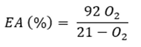
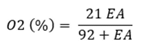
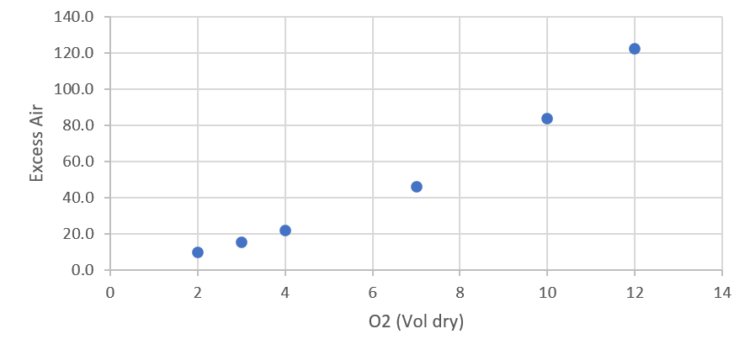
Process heaters do not operate at exactly the right amount of air, so we need to provide “excess” air to the system to ensure complete combustion of the fuel. The recommended excess air level for a gas fired process furnace is 15%, according to industry recommended practices, like API 535. In certain process plants, such as ethylene and hydrogen production, furnaces operate steadily at high temperature. Here, the industry norm is an excess air level of 8 – 10%. Combustion of liquid fuels, on the other hand, requires excess air levels of 20 – 25% to prevent soot formation. Since the operator of the furnace typically only knows the firebox oxygen level, use the following formula to convert to excess air (EA) percentage.

"*" indicates required fields

The equations work well for typical refinery fuel gas mixtures but deviate for fuels that are very high in inerts, hydrogen or carbon monoxide.
graph1

"*" indicates required fields

Fuel efficiency of a fired heater is an important indicator. It tells you how close the heater runs to the design sheet conditions, if there is fouling or damage causing excess fuel use, and ways to improve capacity or fuel consumption. The precise calculation of the fuel efficiency is a bit of an undertaking, as shown in Annex G of API 560, which requires the fuel composition, excess air, stack temperature, fuel temperature, combustion air temperature, etcetera.

"*" indicates required fields

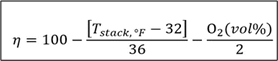
If you do not know the excess air but only the stack O2 content, the Imperial version of the formula is faster.

These linear equations are only valid for O2 < 5%; above 5% the efficiency drops exponentially.

"*" indicates required fields

Fired heaters are typically controlled to a draft of around 0.05 – 0.15 in.H2O at the exit of the firebox. Sometimes we need to know what the draft is in other locations, for example if we want to estimate the pressure drop over a natural draft burner. Since draft varies linearly with height inside the firebox, this can be easily estimated with the vertical distance (in feet) between the location of the draft measurement and the point of interest.

For natural draft burners, this is the maximum available pressure drop for the combustion air.

"*" indicates required fields

If the performance of a burner is known at one condition (i.e. the design conditions on the data sheet), you can estimate the effect of changes, like air temperature, on capacity.

"*" indicates required fields

"*" indicates required fields

"*" indicates required fields

The chemistry of NOx formation is complex, but important since NOx is a major factor in the formation of smog and ozone. The concentration of NOx is usually permitted to a standard oxygen concentration to prevent dilution effects that obscure the real emission values. The typical standard for fired heaters is 3 vol% O2 (dry). To correct an actual stack measurement to the right flue gas O2 level, use this formula.

Reach out to us with questions at info@xrgtechnologies.com.

cropped-logoi.png

XRG Technologies
1855 E 15th Street
Tulsa, OK 74104
info@xrgtech.com
+1 918-201-2656


Please fill out the form below and we will be in contact as soon as possible.
GET IN TOUCH
This field is for validation purposes and should be left unchanged.
Name(Required)
Please fill out the form below and we will be in contact as soon as possible.
GET IN TOUCH
This field is for validation purposes and should be left unchanged.
Name(Required)
ERWIN PLATVOET
As CTO of XRG, Erwin is a true innovator, whose career spans more than three decades in heat transfer and combustion industries. Erwin is a graduate of Twente University in the Netherlands with a MS in Chemical Engineering. Erwin has served the industry around the globe in a variety of roles including Research and Development Engineer, Cracking Furnace Specialist, and Director of Engineering, and now CTO. Erwin holds eight patents in fired heat transfer and emissions control technology, has published numerous papers, and co-authored the John Zink Combustion handbook and Industrial Combustion Testing book. Erwin has been an active member of the API 560 and API 535 subcommittees and taken an active role in revising these standards.
BAILEY HENDRIX
Bailey graduated from Oklahoma State University with a Bachelor of Science in Mechanical Engineering. Upon graduation, she joined the private sector as an Applications Engineer in Tulsa, OK at a local combustion company where she managed the sales activities for the process burner refining market. She quickly accelerated her career, becoming the Refining Account Manager responsible for all business development and sales of process burners in North and South America. Her strong leadership skills and interpersonal qualities led her to a position as the Western Hemisphere Sales Director for the process burner business, leading a group of sales engineers in the areas of new equipment, retrofits and burner management systems. Her financial and commercial acumen drives the success of XRG Technologies’ business development.
ALLEN BURRIS
Allen’s background includes 10 years of experience in designing and selling process burners. Allen is a graduate of Oklahoma State University with a BS in Mechanical Engineering and is a licensed professional mechanical engineer in the State of Oklahoma. His knowledge and superior customer focus led him to a career change to process design, custom-engineered fired heater sales, and associated sub-systems for the petrochemical, refining and NGL industries. With more than two decades of experience in the combustion and fired heater industry, Allen has what it takes to overcome challenges associated with complex projects and possesses.
TIM WEBSTER
With over 25 years of experience in the combustion industry, Tim brings a wealth of industry experience and technical expertise to XRG. Tim graduated with a Bachelor of Science in Mechanical Engineering from San Jose State University and received a Master of Engineering from the University of Wisconsin. Tim began his career engineering custom combustion systems for a wide range of applications including boilers, heaters, furnaces, kilns, and incinerators. Tim is a licensed professional mechanical engineer in the states of California, Texas, Louisiana and Oklahoma, has authored numerous articles and papers, and has co-authored several combustion handbooks.
matt martin
As the Lead Scientist at XRG, Matt has over 30 years of experience in the combustion industry. He specializes in CFD of fired equipment, including UOP platforming heaters, burners in process heaters, thermal oxidizers and flares with over 300 simulations of installed, field-proven equipment. Matt received a Bachelor of Science in Computer Science with a minor in Mathematics from the University of Tulsa. He has written numerous publications, is listed as inventor or co-inventor on 27 patents and was awarded the title of Honeywell Fellow in 2011 for technical excellence and leadership.
gina briggs
Gina is a native Oklahoman and attended the University of Tulsa, graduating with a BSBA in Accounting. She is a Certified Public Accountant and Chartered Global Management Accountant. Gina began her career with the Tulsa office of Deloitte Haskins and Sells, providing audit and tax services. Since leaving Deloitte, she has held CFO positions with privately held companies in the manufacturing, construction and distribution industries. In 2013, she began a consulting practice providing contract CFO services to companies, one of which was XRG and joined XRG as CFO in 2019. Gina has always enjoyed working in the small business arena, helping business owners to profitably grow and manage their businesses.