Since you can’t run a heater simulation every time you’re out in the field, here are some formulas to help fired heater engineers in their daily routine, especially when it comes to estimating the effect of fuel and air changes on burner capacity and heater efficiency.
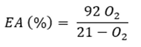
Converting Excess O2 to EA%
"*" indicates required fields
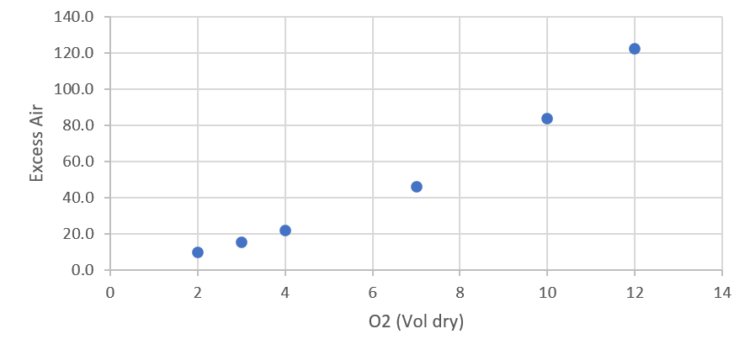
Process heaters do not operate at exactly the right amount of air, so we need to provide “excess” air to the system to ensure complete combustion of the fuel. The recommended excess air level for a gas fired process furnace is 15%, according to industry recommended practices, like API 535. In certain process plants, such as ethylene and hydrogen production, furnaces operate steadily at high temperature. Here, the industry norm is an excess air level of 8 – 10%. Combustion of liquid fuels, on the other hand, requires excess air levels of 20 – 25% to prevent soot formation. Since the operator of the furnace typically only knows the firebox oxygen level, use the following formula to convert to excess air (EA) percentage.
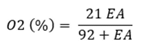
Converting Excess Air to % O2
"*" indicates required fields
The equations work well for typical refinery fuel gas mixtures but deviate for fuels that are very high in inerts, hydrogen or carbon monoxide.
Fired Heater Efficiency (Metric)

"*" indicates required fields
Fuel efficiency of a fired heater is an important indicator. It tells you how close the heater runs to the design sheet conditions, if there is fouling or damage causing excess fuel use, and ways to improve capacity or fuel consumption. The precise calculation of the fuel efficiency is a bit of an undertaking, as shown in Annex G of API 560, which requires the fuel composition, excess air, stack temperature, fuel temperature, combustion air temperature, etcetera.
Fired Heater Efficiency (Imperial)
"*" indicates required fields
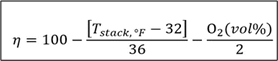
If you do not know the excess air but only the stack O2 content, the Imperial version of the formula is faster.
These linear equations are only valid for O2 < 5%; above 5% the efficiency drops exponentially.
Firebox Draft
"*" indicates required fields
Fired heaters are typically controlled to a draft of around 0.05 – 0.15 in.H2O at the exit of the firebox. Sometimes we need to know what the draft is in other locations, for example if we want to estimate the pressure drop over a natural draft burner. Since draft varies linearly with height inside the firebox, this can be easily estimated with the vertical distance (in feet) between the location of the draft measurement and the point of interest.
For natural draft burners, this is the maximum available pressure drop for the combustion air.
Estimate Burner Air Capacity
Scaling Heat Release
"*" indicates required fields
If the performance of a burner is known at one condition (i.e. the design conditions on the data sheet), you can estimate the effect of changes, like air temperature, on capacity.
Estimate Burner Air Capacity
Scaling Pressure Drop
"*" indicates required fields
Est Burner Air Capacity
Stacking Effects on Excess Air
"*" indicates required fields
NOx Correction
"*" indicates required fields
The chemistry of NOx formation is complex, but important since NOx is a major factor in the formation of smog and ozone. The concentration of NOx is usually permitted to a standard oxygen concentration to prevent dilution effects that obscure the real emission values. The typical standard for fired heaters is 3 vol% O2 (dry). To correct an actual stack measurement to the right flue gas O2 level, use this formula.
Reach out to us with questions at info@xrgtechnologies.com.