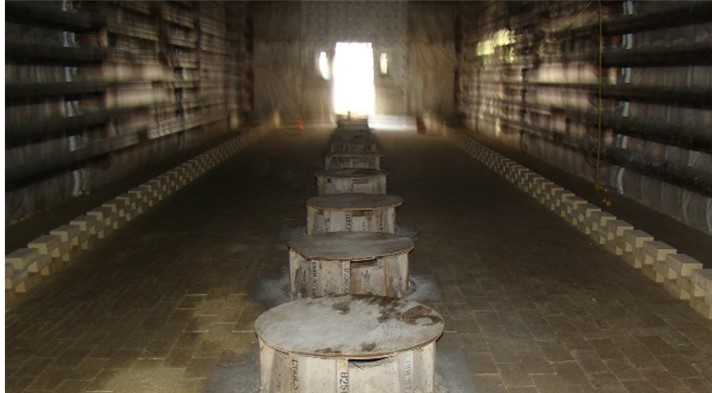
What is the brick wall on the heater floor used for?

By: Joe Tleimat, Senior Principal Engineer

Fired Heater Features – What’s That For?!

There are four main reasons a brick wall (typically 3-5 bricks tall with some space between bricks) is installed on the floor between the burners and tubes:

1. At heater turndown operation, the flue gas recirculation off the tubes can be cool enough to cause high CO emissions, especially with Ultra-Low NOx burners.  A brick wall can help in two ways:

  • by reducing the flow of relatively cool flue gas off the tubes
  • by reradiating heat back to the burners

While not a complete solution, the bricks frequently help the heater run at a 25-50°F lower bridgewall temperature for the same CO emissions.  Unfortunately, as a trade-off, NOx tends to be slightly higher at normal and design heat release if installed correctly.  Also note that if the wall is too close to the burner, too tall, or does not have adequate brick spacing, it can block flue gas flow into the flame zone, which results in much higher NOx. If your heater has CO emission problems at turndown operation and has room to give on NOx emissions, consider adding a wall.

2. Occasionally, flue gas circulation currents in the radiant section are strong enough to push flames around in an undesirable manner, causing impingement.  A common attempt to improve this condition is to install a brick wall to change the flue gas flow patterns. It does not always work but is still frequently tried. CFD modeling is improving at predicting these behaviors and is increasingly used to decide whether to install a wall.

3. For many years, some heater manufacturers installed the brick wall (Reed wall) by default as low-cost insurance against the above issues.  Whether there would be any ill effect of removing the wall was hard to predict prior to CFD modeling.

4. Occasionally a wall is installed to shield the radiant tube bottom guide pins from excessive radiant heat.

If your heater has a brick wall but suffers from issues such as high NOx or poor flame patterns, consider XRG to analyze the situation and get your heater operating at peak performance!


Please fill out the form below and we will be in contact as soon as possible.
GET IN TOUCH
This field is for validation purposes and should be left unchanged.
Name(Required)
Please fill out the form below and we will be in contact as soon as possible.
GET IN TOUCH
This field is for validation purposes and should be left unchanged.
Name(Required)
ERWIN PLATVOET
As CTO of XRG, Erwin is a true innovator, whose career spans more than three decades in heat transfer and combustion industries. Erwin is a graduate of Twente University in the Netherlands with a MS in Chemical Engineering. Erwin has served the industry around the globe in a variety of roles including Research and Development Engineer, Cracking Furnace Specialist, and Director of Engineering, and now CTO. Erwin holds eight patents in fired heat transfer and emissions control technology, has published numerous papers, and co-authored the John Zink Combustion handbook and Industrial Combustion Testing book. Erwin has been an active member of the API 560 and API 535 subcommittees and taken an active role in revising these standards.
BAILEY HENDRIX
Bailey graduated from Oklahoma State University with a Bachelor of Science in Mechanical Engineering. Upon graduation, she joined the private sector as an Applications Engineer in Tulsa, OK at a local combustion company where she managed the sales activities for the process burner refining market. She quickly accelerated her career, becoming the Refining Account Manager responsible for all business development and sales of process burners in North and South America. Her strong leadership skills and interpersonal qualities led her to a position as the Western Hemisphere Sales Director for the process burner business, leading a group of sales engineers in the areas of new equipment, retrofits and burner management systems. Her financial and commercial acumen drives the success of XRG Technologies’ business development.
ALLEN BURRIS
Allen’s background includes 10 years of experience in designing and selling process burners. Allen is a graduate of Oklahoma State University with a BS in Mechanical Engineering and is a licensed professional mechanical engineer in the State of Oklahoma. His knowledge and superior customer focus led him to a career change to process design, custom-engineered fired heater sales, and associated sub-systems for the petrochemical, refining and NGL industries. With more than two decades of experience in the combustion and fired heater industry, Allen has what it takes to overcome challenges associated with complex projects and possesses.
TIM WEBSTER
With over 25 years of experience in the combustion industry, Tim brings a wealth of industry experience and technical expertise to XRG. Tim graduated with a Bachelor of Science in Mechanical Engineering from San Jose State University and received a Master of Engineering from the University of Wisconsin. Tim began his career engineering custom combustion systems for a wide range of applications including boilers, heaters, furnaces, kilns, and incinerators. Tim is a licensed professional mechanical engineer in the states of California, Texas, Louisiana and Oklahoma, has authored numerous articles and papers, and has co-authored several combustion handbooks.
matt martin
As the Lead Scientist at XRG, Matt has over 30 years of experience in the combustion industry. He specializes in CFD of fired equipment, including UOP platforming heaters, burners in process heaters, thermal oxidizers and flares with over 300 simulations of installed, field-proven equipment. Matt received a Bachelor of Science in Computer Science with a minor in Mathematics from the University of Tulsa. He has written numerous publications, is listed as inventor or co-inventor on 27 patents and was awarded the title of Honeywell Fellow in 2011 for technical excellence and leadership.
gina briggs
Gina is a native Oklahoman and attended the University of Tulsa, graduating with a BSBA in Accounting. She is a Certified Public Accountant and Chartered Global Management Accountant. Gina began her career with the Tulsa office of Deloitte Haskins and Sells, providing audit and tax services. Since leaving Deloitte, she has held CFO positions with privately held companies in the manufacturing, construction and distribution industries. In 2013, she began a consulting practice providing contract CFO services to companies, one of which was XRG and joined XRG as CFO in 2019. Gina has always enjoyed working in the small business arena, helping business owners to profitably grow and manage their businesses.