By Tim Webster, Chief Operating Officer
Engineering studies allow end users to develop ways to improve facility operations or help solve specific problems. They can also be used to help understand how custom equipment will perform in the field before installation and investment.
XRG’s team of fired equipment specialists specialize in analyzing and suggesting performance improvement opportunities, focusing heavily on eliminating bottlenecks, reducing emissions, and improving mechanical reliability. Some common areas where engineering studies can provide beneficial input prior to determining a course of action include;
 Troubleshooting problems
- Flame impingement
- High emissions
- High Tube Metal Temperatures (TMT)
- Draft issues
- Tube support failures
- Coking and fouling
- Vibration
- Operational improvements
- Capacity increases
- Emissions reduction
- Efficiency improvement
- Feed changes
- Fuel changes
- CO2 reduction
- Improve efficiency (e.g. adding air preheat)
- Alternate fuels (e.g. hydrogen or ammonia)
- Oxy-combustion for carbon capture and sequestration (CCS)
- Partial or complete electrification
What does an engineering study involve?
While every study is different, they are commonly broken down into three primary phases;
Phase 1 – data gathering
Some studies can be performed through analysis of existing site data, such; as fired heater datasheets, drawings, operational data, pictures, etc. In some cases where complete data is not available, or when the current condition of equipment needs to be assessed, a detailed survey onsite is conducted for visual inspection of the heaters and auxiliary equipment, data collection, and project scope discussion with the user’s team. Data is collected for evaluation using instruments like emissions analyzers, infra-red (IR) cameras, and pyrometers to determine temperatures, pressure profiles, and flue gas constituents. The purpose of the survey is to determine exactly how the fired heater operates, inspect the overall health of the fired heater, and determine what (if any) limitations apply.
Phase 2 – detailed analysis and simulation
In the second phase, all of the documentation and data collected are analyzed and modeled to identify issues and constraints and then evaluate potential solutions. Some of the advanced analytical tools that can be used to simulate and evaluate fired heater operation include;
- Chemical process simulation using DWSIM
- Heater thermal rating using FRNC-5 and our proprietary in-house software Xplore
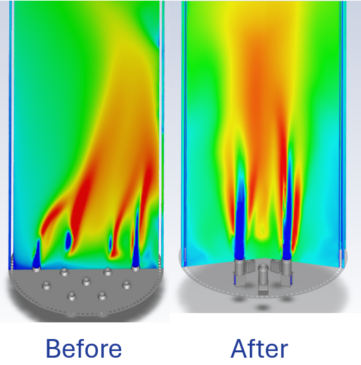
- Computational Fluid Dynamics (CFD) modeling using Ansys Fluent
- Pipe stress analysis using Caesar II
- Structural analysis using RISA-3D and IdeaStatiCa
- Finite Element Analysis (FEA) using Ansys Mechanical
- Detailed 3D design using Tekla Structures, AutoCAD and Solidworks
These tools allow XRG engineers to troubleshoot problems, conduct feasibility studies, provide cost-benefit analyses, and perform thermal ratings.
For example, a CFD model can demonstrate flame patterns, radiant flux profile from the burners, and the resulting absorbed flux and temperature profiles on the coils. This can be used to solve heat transfer problems in the fired heater caused by non-optimal burner layouts or flue gas patterns in the furnace.
The detailed heat flux data that is generated through the CFD model can then be used as an input into our thermal rating software to provide more accurate modeling results and heater performance predictions.
Phase 3 – conclusions and recommendations
XRG will work closely with your engineering, operations and maintenance staff to discuss options and determine the solution that accomplishes your goals in the most cost effective manner. Each solution is custom-developed from real world analysis and modeled to provide options for achieving the desired outcome. When it comes to solving complex issues, trust XRG engineers to evaluate all potential options with actionable solutions and guaranteed results.
Once a solution is chosen, XRG can prepare any equipment proposals, budgets and schedules needed to help you completely understand the impact of any recommended changes. Our expert team can procure all equipment, provide technical support, manage vendors, supervise installation and provide commissioning oversight and support.
Why choose XRG for your next engineering study?
- Objective: XRG is not tied to any specific burner vendor or technology. We neutrally assess the problem and suggest the best solutions for the specific case.
- Experience: We have years of experience as combustion and heat transfer experts with field installation experience that gives the confidence that we can not only solve the problem but implement that solution in the field.
- Advanced Tools: a wide suite of advanced analytical and design tools to ensure that every step, from analysis to implementation, is studied thoroughly and any risks are identified and mitigated up front.
- Value: XRG puts customer goals first and develops solutions that take into account safety, reliability, fired heater efficiency, fuel savings, longer equipment life, and reductions in emissions like CO2, NOx and CO. We are so confident we can develop a solution for you that we offer a “no cure no pay” study option allowing you to be confident in your investment!