 I was watching a video on YouTube where kids react to old computers. It was great to watch their astonished reactions to an ancient looking computer (the Apple IIe) that we considered advanced in the eighties. When the interviewer mentioned that today’s cell phones are almost a thousand times more powerful than that big grey box in front of them, it occurred to me how fortunate I have been to witness this great development of computing power. The incredible advance of computer chips follows Moore’s Law. For those who don’t know it, it is an observation made in a 1965 paper by Gordon Moore, the co-founder of Intel. He predicted that the density of integrated circuits would double every year for at least a decade. It was later adjusted to doubling every two years and that rate is still, amazingly enough, applicable.
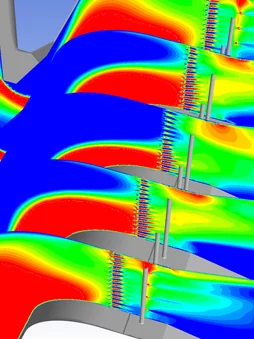
In the world of Computational Fluid Dynamics (CFD) it means that serious simulation capabilities are now within reach for anyone that can afford a 1500-dollar laptop. But more computing power does not automatically increase the chance of success; there are plenty of recent examples where CFD predictions have been somewhat or completely wrong, especially in the trickier ones such as those that involve combustion and radiation.
In general, the best simulation results are typically achieved when the correct answer is known beforehand! And that is the case for CFD too.
For instance, using a steady-state assumption for a problem that is in fact unsteady or transient either results in a convergence issue or worse, a completely wrong answer.
The user must already have a good grasp on…
- the flow phenomena that are to be simulated?
- what is the flow regime?
- what is the dominant heat transfer mode?
- is the combustion mixing rate limited or kinetically limited?
- is the flow steady-state or more of a transient nature?
- does gravity play a role?
CHALLENGES IN CFD MODELING OF COMBUSTION SYSTEMS
Problems arise when a user of a simulation code is more focused on the numerical results (i.e. solution convergence) than on the simulation results.
Another problem can be caused by the myriad of models that are accessible in commercially available CFD codes, with each of these models having a plethora of tunable parameters. For example, ANSYS Fluent offers more than a dozen turbulence models, just for steady state simulations. A user will be easily lured by the advanced features of the newer models that can account for a wider range of flow phenomena. However, combustion models that use turbulent mixing rate like the Magnussen-Hjertager model have been developed and tuned in the 1970s using the standard k-e turbulence model. Using it in combination with a more modern turbulence model without retuning the mixing constants can result in drastically different (and wrong) results.
KEYS TO SUCCESSFUL CFD MODELING
Good CFD results are easier to obtain when the simulation focuses on one type of flow issue like the aerodynamics of objects such as cars and plane wings. Good CFD results are also likely when experimental data are available to demonstrate the validity of the simulation approach. Think of combustion test data, wind tunnel results or similar lab data that are obtained under known and controlled conditions. Problems are more likely to occur when CFD simulation is attempted without knowing the expected results or having any experimental data for validation. In any case, product engineers and simulation experts need to collaborate to ensure the proper model approach is used and that the simulation results make sense.
THE NEED FOR CFD STANDARDS
Engineers performing CFD simulation consider a variety of constraints – computing resources, time available to complete project, the desired information sought from the simulation and the modeling assumption that help simplify the real-world problem into a realizable, non-trivial CFD simulation.
This engenders numerous approaches across the board for the same type of CFD simulation and hence, beget a variety of outcomes that each could lead to different engineering judgement.
To aid proper decision making, customers using CFD analysis need to understand the quality and limitations of the CFD analysis. The simulation report may contain details specific to the project, but it does not enable categorizing the analysis to a specific standard.
There is a clear need to set up industry standards or specifications that will help customers use results from CFD simulation in a consistent and reliable manner. This includes mesh resolution, convergence and physics models used.
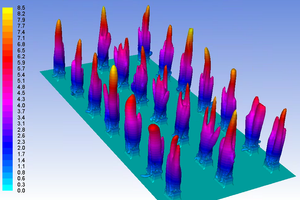
For example, a perforated plate may be modeled as a porous resistance without any details of the perforation. This can be certified as a Level 1 analysis. In many instances, this may be adequate detail to answer the question at hand. In another instance, an accordion style perforated plate may be required to model with the complete details of the accordion plate and the perforations on it to study wake modeling and flow mixing, say, of aqueous ammonia from AIG lances into the flue gas stream. This could be certified as a Level 3 analysis. Furthermore, if the analysis includes heat transfer effects including conjugate heat transfer, then it could be certified as a Level 5 analysis.
Each of the analysis approaches are valid approaches for CFD but the suitability of the analysis depends on the customer request and the intended use of the analysis.
- Cramming more components onto integrated circuits – Moore, Gordon E. – Electronics Magazine (1965) p. 4.
- On mathematical modeling of turbulent combustion with special emphasis on soot formation and combustion – B.F.Magnussen, B.H.Hjertager – Symposium (International) on Combustion – Volume 16, Issue 1, 1977, Pages 719-729