As seen in Hydrocarbon Engineering – October 2023 Issue
Matthew Martin, XRG Technologies, details how the installation of a dispersed combustion system and explains how the technology can help refiners and petrochemical producers reduce emissions.
Success: First Installation of a Dispersed Combustion System
In our 2022 Hydrocarbon Engineering Article “A Call for Action: Unfire your Heater for Better Performance” (Martin, 2022) XRG Technologies presented the case for dispersed combustion in existing fired heaters. Just one year later, we are excited to report the successful implementation of XRG’s Xceed™ Technology in an operating crude heater.
The Xceed Technology is a dispersed combustion system that can be retrofitted to existing fired heaters. A portion of the fuel gas is diverted from the burners to specialized nozzles that precondition the fuel gas with flue gas before it is ejected into the radiant section. The resulting diffuse oxidation increases heat transfer uniformity at the tubes, increases tube surface utilization, and reduces NOx formation. This allows increased capacity of existing fired heaters and reduced NOx formation, even when adding preheated combustion air to increase fuel efficiency and reduce carbon dioxide emissions. Figure 1 shows the major components of the Xceed system in the radiant section of a fired heater.
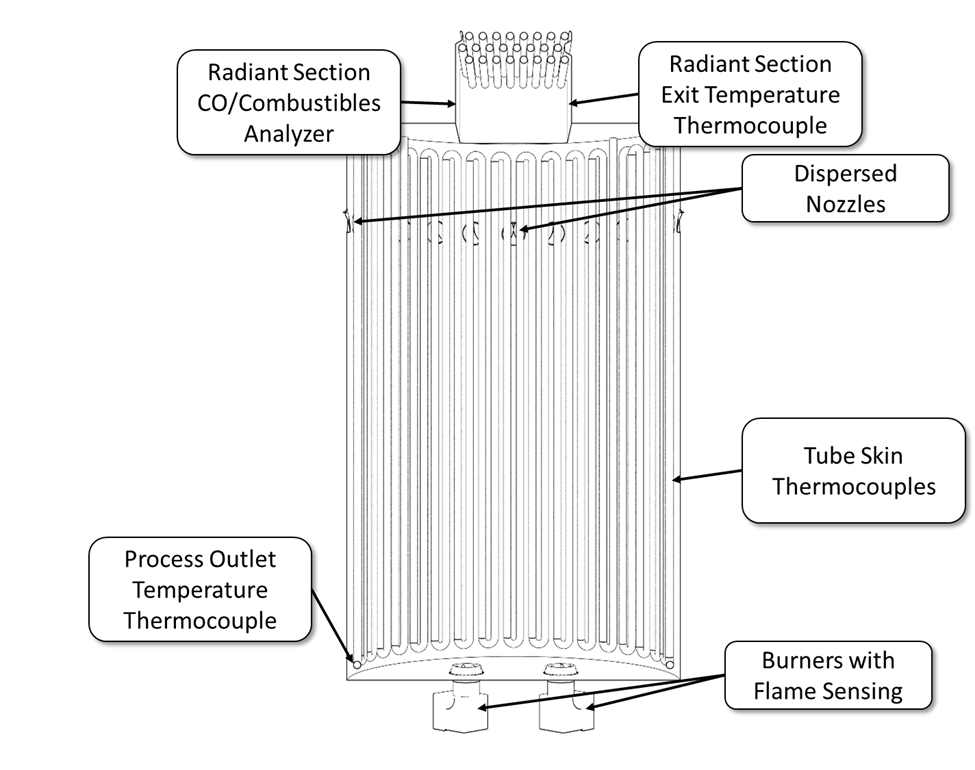
Figure 1 – Components of the Xceed dispersed combustion system in a cut-away view of the radiant section of a fired heater.
Project Background
An XRG customer in the Netherlands sought to improve the performance of an existing crude heater. The original heater had been in service for decades and suffered from several problems. The heater tubes had severe tube degradation caused by creep, there was a short run length between decoke operations, and the heater itself was a capacity constraint for the entire refinery. The flames of the existing first-generation ultra-low NOx burners impinged on the heater tubes leading to increased creep and coking. Any attempt to increase the feed rate to the heater resulted in overheating of the shock tubes and an increase in coking rate. Additionally, a thermal analysis by XRG revealed that the convection section of the heater had significant convection section fouling and fin degradation.
XRG simulated the current operating conditions using thermal rating tools and computational fluid dynamics (CFD). The future, ideal state of the heater was calculated using the same tools.
Figure 2 shows a composite image of the CFD simulation and the actual operation with the original ultra-low NOx burners and the new forced draft burners. XRG installed a balanced draft combustion air preheating system to recapture waste heat from the heater. The number of burners was reduced from 15 to 5 to optimize the firebox aerodynamics and eliminate flame cloud impingement on the heater tubes.
These improvements resulted in the following performance gains:
- Fuel efficiency increase from 78% to 91%
- 15% reduction in CO2 emissions at the equivalent capacity
- Capacity increase of 30%
- NOx emissions < 70 mg/Nm3 when firing purchase gas (natural gas)
- Eliminated flame impingement on the radiant tubes

Figure 2 – [Top] The original natural draft burner flames in practice and CFD simulation. [Bottom] the new, forced draft burner flames in practice and simulation.
Dispersed Combustion
Soon after the initial project, the end user contacted XRG to request additional improvements. Greater heater capacity was required as part of an overall refinery debottlenecking project. Additional fuel gas was available at the refinery composed mostly of butane and propane that could be fired instead of purchasing natural gas.
instead of purchased natural gas caused long flames which increased the bridgewall temperature, the shock tube temperature, and the peak radiant section temperature. The daily differential rise in temperature indicated that short run lengths would result. Additionally, NOx would exceed the prescribed limits when operating on the new heavier fuel blend.
Through modeling, XRG determined that burner technology alone could not alleviate the peak flux in the radiant section (which in turn resulted in high tube metal temperature).
XRG installed Xceed nozzles at two elevations to introduce preconditioned fuel gas into the heater. The dispersed combustion from the portion of the fuel diverted to the Xceed nozzles occurs at a substantially lower temperature than that of flame. The low-temperature oxidation reduces NOx production from the diverted portion of the fuel to effectively zero. The disposition of the nozzles decreases the peak tube metal temperature – even at increased heater capacity – below the tube metal temperature limit. Figure 3 shows the Xceed nozzles installed on the crude heater.
The nozzle is installed through a small hole in the side of the heater. No operator intervention is required at elevation, and all control is achieved automatically and from grade. The fuel ports are much larger than those of a burner and are shielded behind the tubes and within the Xceed nozzle which leads to a low propensity for plugging. Additionally, the nozzles can be removed from service without shutdown.
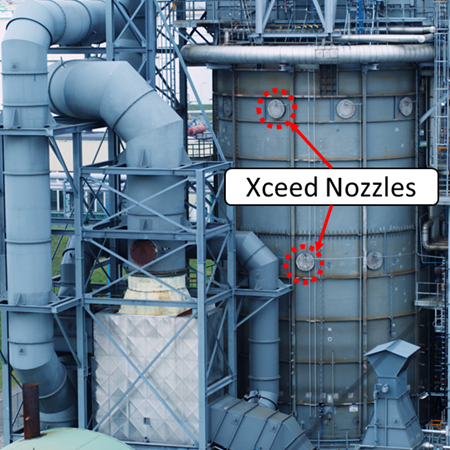
Figure 3 – Xceed nozzles installed on the crude heater.
Simulation and Optimization
XRG performed computational fluid dynamic simulations to determine the optimal placement of Xceed nozzles. Figure 4 shows the simulated surface incident radiation using burners only with Xceed. When operating on burners only, the heat flux to the tube increases along the height of the firebox. This results in low radiant section efficiency, high bridgewall temperature, and high heat flux at the top of the firebox. The Xceed system moves the peak heat flux lower in the radiant section. The average heat flux in the firebox is higher than when operating with burners only and integrating heat flux over the elevation results in more heat transfer. At the same time, the local peak heat flux is reduced, resulting in lower peak tube temperature.
This increased heat transfer reduces both the average operating temperature and the peak temperature of the tubes. This allows for an increase in heater capacity without exceeding the allowable tube metal temperature and reduces coking of the heater tubes.

Figure 4 – Surface incident radiation with burners only and Xceed in operation.

Table 1 – Selected measurements from the crude heater before improvement, with new low NOx burners, predicted from CFD simulation, and measured in practice.
Controls and Instrumentation
The Xceed system installation is EN-746 compliant and requires minimal additional equipment. The major control components are a set of three-way valves to divert fuel flow to the Xceed nozzles when in operation. Additional thermocouples were added to measure performance but were not required for operation.
The start-up and shutdown procedures remain exactly as they were pre-modification. No operator intervention is required when Xceed is in operation. In all aspects, the operation of the heater is identical to using burners only.
Field Results
Table 1 shows measures from the heater before improvement, with new ultra-low NOx burners, predictions from CFD simulations, and results of the installation of Xceed.
The absorbed duty increased 33%, from 55 MW to 73 MW. At the same time, the peak tube-metal temperature at the location of the original thermocouples decreased from 460°C to 400°C. The operator reported that radiant section coking has effectively ceased. The NOx production was reduced from the already very low 36 ppm (75 mg/Nm3) to 18 ppm (37 mg/Nm3). The Xceed Technology increases the radiant section heat transfer by 6% or more, which reduces the crossover temperature and peak temperature in the convection section as well. The XRG simulation of the system predicted tube metal temperature at the same location within 1°C and the NOx within 1 ppm of the actual performance, showing that reliable, repeatable, and predictable performance is possible.
The overall heater efficiency increased from 81% to 92% when operating at equivalent excess air. This efficiency increase is equivalent to a 12,207 t/y of reduction in CO2. At the current increased capacity and fuel mix this metric improves to 22,500 t/y. One remarkable byproduct of the system is that the fuel efficiency increases while the absorbed duty increases with all else equal. This is normally not possible and points to the effectiveness of increased tube surface utilization.
Figure 5 shows the burners inside the radiant section with the Xceed nozzles in operation. The flames are compact, well formed, and away from the tubes, and there is no extraneous visible combustion from the Xceed nozzles, as per the design.
Economic Impact
Precise measures of the economic impact on the refinery are unknown. However, investing in Xceed technology in conjunction with the enabled capacity increase can demonstrably improve refinery economics in several ways. The following hypothetical benefits for the case study can be calculated: First, if the increased efficiency is used solely to offset purchased natural gas, a heater of the same size operating 340 days per year with a reduced firing rate of 7.48 MW (11% of 68 MW) and an assumed natural gas price of 28 USD/MWh results in savings of 1.7 million USD/y. At the same time if CO2 is priced at 112 USD/t and one assumes 200 kg CO2 / MWh this represents an additional savings of 1.3 million USD/y. If the crude heater is the refinery bottleneck, using the Xceed Technology in conjunction with an air preheater to increase the throughput from 100,000 bpd refinery to 133,000 bpd implies an increase in profits of 125 million USD/y with a 8.9 USD/barrel crack spread. It is noteworthy that the assumed crack spread is highly dependent on the specific refinery.

Figure 5 – The heater operating at 79 MW fired duty with Xceed in operation.
Summary and Conclusions
Refiners and petrochemical producers that use fired heaters are being challenged to reduce CO2 emissions while maintaining or increasing plant profitability. Our technology can be implemented in less than a year and make a substantial impact on CO2 reduction and refinery capacity. Operating plants face increasing risk from high fuel gas and carbon dioxide prices as well as the demand for increased production. Utilizing dispersed combustion with efficiency increasing measures provides a proven path to realizing environmental and economic goals.
Xceed technology in conjunction with additional heat recovery has provided an 11% fuel efficiency increase in combination with a 33% capacity increase while reducing NOx and peak tube metal temperature.
The reduction in peak temperature combined with no need for a flame front makes the Xceed system a candidate to ease the implementation of hydrogen and ammonia firing. This new technology creates a path toward greater economic and environmental performance from existing heaters.
References
Martin, M. (2022, July). A Call for Action: Unfire Your Heater for Better Performance . Hydrocarbon Engineering.