By Joe Tleimat
The circled portions of the heater stacks are commonly referred to as velocity cones (or tips). A velocity cone is a cone-shaped stack extension added to some fired heaters to increase stack exit velocity.
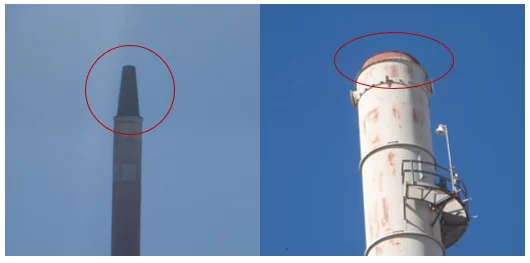
Here are three common reasons to increase the exit velocity:
- It reduces the downwash of flue gas at the tip which causes stack metal corrosion. Some companies specify a minimum stack exit velocity (of 10-15 fps) at turndown operation for this reason. Using a stainless-steel tip instead of carbon steel can solve this issue.
- A side benefit of higher stack exit velocity is that it provides some dampening of the effect that wind gusts have on heater draft variation.
- Occasionally the stack flue gas dispersion analysis uses 50 feet per second as the exit velocity to determine the minimum stack height required. This is a common practice in the boiler industry.
- For boilers, flue gas dispersion analysis typically assumes 50 feet per second (fps) stack exit velocity as the basis. The stack height is then set to provide the desired flue gas dispersion. This does not have a significant impact on a boiler design or cost since boilers typically have fans that move flue gas. The stack pressure drop is typically insignificant compared to the entire boiler system pressure drop.
- On the other hand, natural draft heater stacks are sized differently. Natural draft stacks are typically most cost-effective with 20-30 fps stack exit velocity (compared to 50 fps for boilers). If designed for 50 fps exit velocity, the pressure drop (incremental vs an exit velocity of 20-30 fps) would be in the range of 0.15 – 0.25 inH2 This is a sizable portion of the draft generated by the stack. Unfortunately, personnel responsible for the flue gas dispersion analysis typically do not have this appreciation. Therefore, a minimum 50 fps exit velocity is specified and the dispersion analysis is carried out to establish a minimum stack height. Frequently, the height required from a draft perspective is considerably higher than the height for dispersion requirements. Overcoming this extra pressure drop can add 30-60’ to the stack height of a natural draft heater. Not only does the stack cost more, but the heater structure and foundation become more substantial and costly. To minimize the cost and size impact, the stack designer typically only reduces the diameter of the very top of the stack to achieve the desired exit velocity instead of the entire length of the stack. This avoids additional pressure drop associated with higher stack frictional losses. A simplified dispersion calculation suggests that a 100’ tall stack with 50 fps exit has the same dispersion characteristics as a stack at 25 fps and 105-110’ tall.
If you have a heater with a velocity cone sized for >40 fps and is draft limited, consider redoing the dispersion analysis with a lower exit velocity. You may discover you can remove the cone and gain 0.15-0.25 inH2O of draft.
Have questions about velocity cones? Contact us at info@xrgtechnologies.com!